Re: DIÁRIO DE BORDO - mike
Enviado: 23 nov 2011, 23:57
Atenção que além da baixa resistência, há a considerar o peso normal do veículo ser superior á média. 
Fórum de discussão sobre a Mobilidade Elétrica e Parceiro privilegiado da Associação de Utilizadores de Veículos Elétricos - UVE
https://www.clubeletricos.com/
Sim, por acaso falei nisso ao Sr e ele disse que aquele pneu que tinha vindo (Made in Spain) era exactamente com as mesmas caracteristicas, mas tinha o desenho do piso semelhante (também com os 3 trilhos em todo o perimetro) mas diferente nos outros perpendiculares...Filipe Escreveu:Atenção que além da baixa resistência, há a considerar o peso normal do veículo ser superior á média.
Este estudo foi feito com um Prius e os resultados estão em MPG, no entanto a diferença dos Ecopia para os pneus mais fracos foi de 6%. Os Michelin Energy Saver ficaram à frente dos Ecopia, mas se calhar os Michelin não são mais baratos.TimLee wrote:
Is forgetting LRR tires and replacing all with non-LRRs that cost markedly less and have better handling a better economic and safety choice down the road?
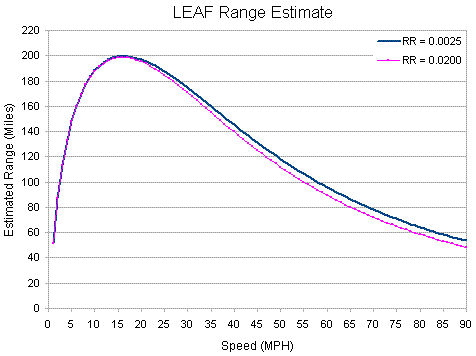
Now every time I post a graph from my model I'm careful to put a disclaimer on it, and this is no exception: the model is very simplistic and makes a lot of assumptions. However, as it stands it seems rolling resistance makes a pathetically small contribution to range variationI'd be glad to be wrong about this, though. Rolling resistance coefficients of 0.0025 and 0.0200 are chosen as extreme cases on either end to try and get the lines to diverge - I have no idea what the actual coefficients might be for the EP422 and a normal tire.

http://www.gavinshoebridge.com/electric ... -worth-it/Low Rolling Resistance Tires – Are They Worth it?
Low Rolling Resistances Tires are designed to increase your car’s economy by reducing the amount of tire friction or resistance while driving. This means your engine or electric motor & batteries don’t have to break into a sweat just cruising down the road. In some cases the energy savings can be noticable, with up to 15% of the gasoline consumed by a typical car due to rolling resistance.
After reading that, buying a set of LRR tires for an electric vehicle sounds like a no brainer, but I recommend taking all things into consideration first, such as cost and lifespan. Depending on how much of your driving is at high speed (50+ mph) these “Tires of the Gods” may not be so heavenly after all.
For example, the differences many drivers have mentioned in the real world have been around the 2 miles-per-gallon mark. If the average set of a new set (four) of LRR tires cost $500, then it would take some time to pay itself off.
To give you an idea, let’s look at two simplified examples, both driving 30 miles per day:
Car 1 has normal tires and travels 30 miles per day at 0.3 kWh per mile, which equals 9 kWh per day. If 9 kWh per day costs $0.16 per kWh, then that’s $1.44 per day in electricity.
Car 2 has LRR tires and also travels 30 miles per day at 0.27 kWh per mile, which equals 8.1 kWh per day. If 9 kWh per day costs $0.16 per kWh, then that’s $1.30 per day in electricity.
As you can see, I’ve given “Car 2″ an improvement in economy by 10%, which has saved the driver $0.14 cents a day in electricity. This means the tires would have to last 9.7 years (or 107,000 miles) before they’d pay themselves off in saved electricity costs.
When used in a gasoline powered car however you could expect a faster payback, though this is only due to the fact that gasoline cars are inherently inneficient and use much more money in fuel per-mile than an electric vehicle.
Another option for those on a budget is to find older, used tires with a hardened tread. This harder tread doesn’t flex and heat up (losing energy as heat) as much as newer, softer rubber. The gains would be minimal in a typical electric commuter vehicle as shown, but may help with a longer range electric vehicle or gasoline vehicle.
If you have a long range electric vehicle, and if you drive long distances regularly then the benefits of installing LRR tires are there. For Jo or Joanne Average who drive small, local-range electric cars I suggest to stick to their usual budget brand.
If you’re buying new LRR tires then you should be aware of their reputation for having less grip in wet conditions due to their harder tread, and/or higher required tire pressure. Keep this in mind if you live in a wet area and ask your supplier for statistics on the particular tire you’re interested in.
Era o que faltava agora a escolha da marca de pneus afetar a garantia!Filipe Escreveu:Acho boa ideia criar um tópico próprio, pois se a diferença não justifica o preço, deve-se averiguar se usar outros pneus além dos
recomendados ,vai ou não afetar as garantias dadas pela Nissan.


pois, editei a minha mensagem, e quando enviei já estava a sua.Filipe Escreveu:O V é capaz de lá estar, porque se calhar não fabricam pneus de baixa resistência com outros valores.


 vamos esperar para ver
Não é azar. Os fiscais da EMEL não foram informados.mikexilva Escreveu:Pois é, hoje foi o primeiro dia que o nosso LEAF saíu à rua com o dístico verde da EMEL colado no vidro da frente, e por coincidência a minha mulher tinha uma consulta no hospital da CUF, e como foi um dia de greve, muita gente deve ter trazido o carro para Lisboa, e os estacionamentos estavam a abarrotar, mas lá encontrou um lugar com parquímetro da EMEL nas proximidades do hospital, mas quando regressou, teve a infeliz surpresa de uma multa da EMEL no valor de 3,2eur (correspondente ao tempo máximo de estacionamento permitido).
Justificação da multa:
- O pacómetro se encontrava em funcionamento
- A viatura exibe dístico válido para outra zona.
Tendo em conta que desde que temos o LEAF (2,5 meses) estacionou 2 vezes em parcómetros da EMEL (a contar com esta), não sei se foi azar logo no primeiro dia ter que estacionar e levar a multa...